
Every team we talk to has faster tools than they did a year ago. AI can draft emails, summarize meetings, and spin up first versions of almost anything. And yet the same projects stall in the same places they always have. The bottleneck isn’t speed. It’s that nobody wrote down how the work actually gets done, so every decision still routes through the same person. If you want to document business processes in a way that actually helps your team, you have to start before any new tool enters the picture.
The Bottleneck Moved, but It Didn’t Disappear
When a company adds AI to a workflow that hasn’t been mapped out, the tool finishes its part quickly and then waits. According to an Anthropic report covered by Fortune in October 2026, 80 percent of the elapsed time in Claude sessions came from agents waiting on a human’s input. The same report noted that the median Anthropic employee now spends 20 percent more time in meetings than a year earlier. Faster outputs didn’t reduce the time people spent deciding, explaining, and aligning. They just made the human steps more visible.
In founder-led companies, this pattern is especially familiar. The founder is often the person who holds the context for how things should look, sound, and feel. That’s not a flaw. It’s how the company built its standards. But when that context lives only in one person’s head, every piece of work has to pass through them before it moves forward. A new AI tool doesn’t change that. It just produces more drafts for the same person to review.
Three Questions to Document Business Processes That Keep Stalling
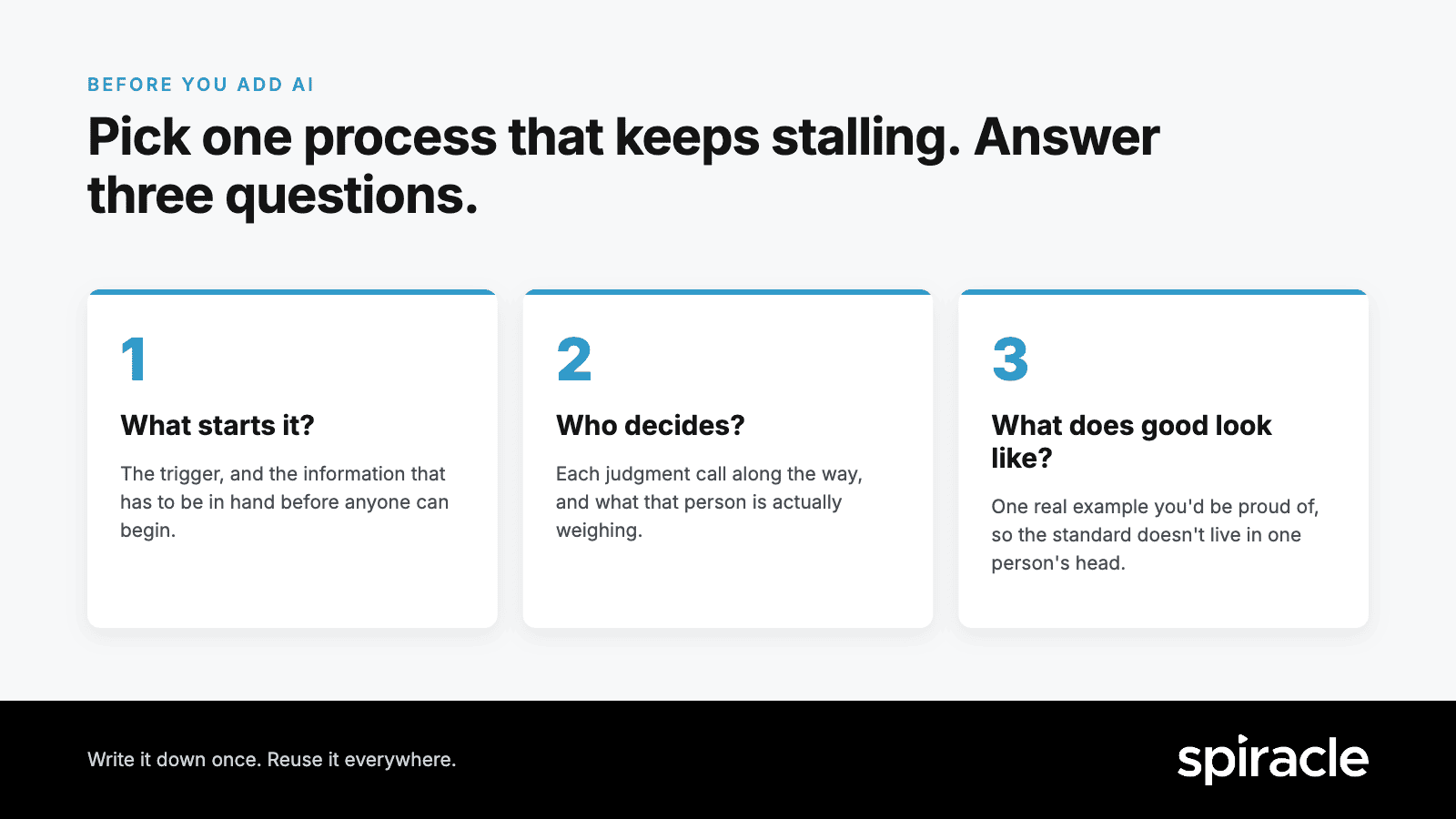
Michelle Taite and Will Fernandez wrote in Harvard Business Review (October 2026) that marketers need to codify the judgment, rules, and expertise that experienced people apply intuitively before they can expect AI to help. Costs and complexity often rise before gains appear. We’ve found the same thing in our own work. The fix isn’t exciting, but it works. Pick one process that keeps landing on the same person’s desk and answer three questions about it.
- What starts it, and what information has to be in hand? Name the trigger (a request comes in, a deadline hits, a partner asks for something) and list the specific inputs someone needs before they can begin. If people regularly start without the right information, that’s the first thing to fix.
- Who decides at each step, and what are they weighing? This is where the real knowledge lives. Write down the judgment calls, not just the tasks. If the founder always reviews tone, say so. If the project manager checks scope against budget, say that too. Making these calls visible is what lets someone else eventually make them.
- What does a good result look like? Include one real example. A finished example removes ambiguity faster than a paragraph of instructions. Pull a past project that went well and attach it. Point to what made it right.
Written Down Once, Reused Everywhere
A written process isn’t just a checklist for today. It becomes the brief for a new hire’s first week. It becomes the scope document you hand to an outside partner so they don’t have to guess. It becomes the template your team opens every time the same type of project comes around. And yes, it becomes the prompt or instruction set that makes an AI tool actually useful, because now the tool has the context it was missing. This is how we work through our Momentum Team with founder-led companies. We find the one constraint costing the most momentum, build the fix, and install it so the team can run it. The written-down process is almost always where that starts.
At Spiracle, our own weekly content batches, proposal drafts, and follow-ups all run on workflows we wrote down first. Some of those workflows now include AI at specific steps where it removes friction or saves real time. Where it doesn’t, it stays out. The point isn’t to use every tool available. The point is to know your process well enough to decide where a tool earns its place. We approach pre-production the same way. Before cameras roll, we work through a set of questions that shape the entire project, because the thinking that happens before production is what makes the final piece work.
Start with One Process This Week
You don’t need to map every workflow in your company at once. Pick the one that keeps stalling, the one where the same person gets pulled in every time, and write down how it really works using those three questions. It’ll take an hour, maybe less. Once it’s written, you’ll have something your team can follow, your next hire can learn from, and your tools (AI or otherwise) can actually support. When you document business processes one at a time like this, the progress compounds, and it doesn’t require a single new subscription to get started.